Projects
RAVEL

Originally developed as a solver for modeling electron beam remelting, the software has evolved into a comprehensive package for simulating the vacuum arc remelting (VAR) process. It comprises two main components: RAVEL (the core solver) and RAVEL UI (the graphical interface).
RAVEL offers the following capabilities:
- Ingot growth modeling using dynamic meshing, with support for horizontal and vertical mesh refinement.
- Electromagnetic field calculations, including current density and induced magnetic fields, with support for temporally and spatially varying asymmetric arc current distributions.
- External magnetic field stirring.
- Advanced lateral cooling models.
- Radiative cooling at the ingot top, using both simplified and view-factor-based approaches.
- Solute evaporation modeling at the ingot surface.
- Ingot shrinkage simulation.
- Gas cooling mechanisms.
- Solidification modeling.
- Mass transfer and microsegregation analysis.
- Defect formation prediction.
- Multiple user-selectable turbulence models.
- Cross-platform compatibility (Windows and Linux).
- Support for massively parallel simulations.
RAVEL UI is primarily used to prepare case files for execution on computing clusters. Alternatively, a Python interface is available for case setup and batch execution workflows.
Read moreOpenFOAM(R) on macOS
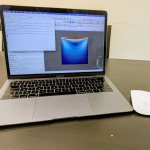
This project originated as a personal initiative to compile OpenFOAM on macOS without relying on MacPorts. Instead, it utilizes Apple’s Clang compiler and Homebrew as the package manager, benefiting from its binary package support.
The project is currently in a hibernation state, as OpenCFD has incorporated most of the relevant patches into the official OpenFOAM repository. It is now primarily maintained for its wiki, which contains build instructions and related documentation.
Read moreContinuous Casting Cooling
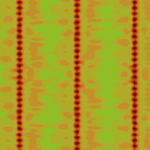
The objective of this study is to model the cooling of a moving solid strip using water jets. The simulation requires tracking the liquid–solid interface, modeling potential nucleate boiling at the boundary, and solving heat transfer within the product, incorporating both diffusion and convection under a fixed velocity field.
After several initial attempts, the final approach involved developing a conjugate heat transfer solver. This solver couples an incompressible Volume-of-Fluid (VoF) method with phase change modeling in fluid regions and a simplified heat transfer solver in solid regions. Nucleate boiling is represented as a source term in the energy equation on the liquid side of the liquid–solid interface.
Read moreGas Stirred Ladle
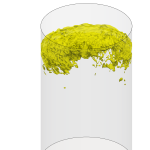
The aim of the study is to model interaction between steel and slag, to calculate steel/slag mass transfer coefficient, and to predict critical gas flow rate, where mass transfer mechanism is changed.
Initial simulations were performed on the base of the water/oil model of the ladle. For the simulations incompressible multi-phase solver with Volume-of-Fluid interface tracking algorithm is used. Dynamic mesh refinement is used on water/oil and water/air interfaces for correct shear stress prediction. To reduce simulation time we attempted to use load balancing, yet finally we opted for weighted mesh decomposition, which is more stable.
Read moreContinuous Casting Mold
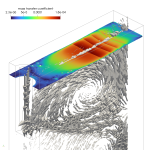
The study investigates the interaction between liquid steel and slag within a continuous casting mold using computational fluid dynamics. Two geometries were considered: a scaled hydraulic water/oil model and an industrial-scale mold containing liquid steel, slag, and optionally injected argon gas. An incompressible multiphase solver with interface tracking was employed for both cases. The water model results were validated quantitatively against experimental data from Mass transfer coefficients across dynamic liquid steel/slag interface, while the industrial-scale simulations and the effects of argon injection were analyzed qualitatively due to limited experimental data.